
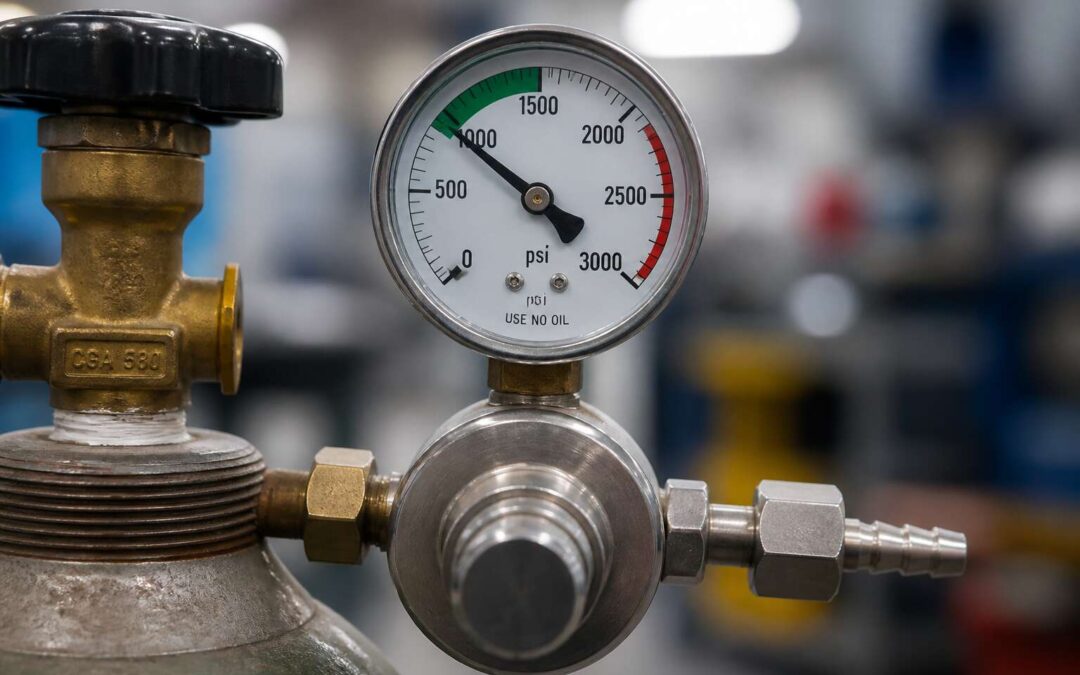
Decoding the Dial: Understanding Your Cylinder Pressure Meter
The Vital Role of Pressure Monitoring in Gas Systems
Nearly every South African kitchen, workshop, and braai area relies on the silent, invisible utility of compressed gas. Yet we so often trust the brass fitting on top of the cylinder without a second thought. That small circular face, with its needle and coloured zones, is a story teller. It translates the physical struggle of vapour pressing against metal into a language we can understand.
The dial itself is a map of safety. When the needle rests firmly in the green sector, the system is breathing normally, delivering the correct pressure to your appliance. Once it strays into the red, the situation has changed. This is not a time for guesswork. A reading that is too high can indicate overfill or exposure to vigorous heat, while a reading that drops to zero might mean the cylinder is empty or, more concerning, that a valve has failed.
- Check the needle position while the appliance is running to gauge flow.
- Observe the needle with the valve closed to see the static pressure.
- Look for the coloured zones that usually indicate the safe operating range.
- Notice any trembling or fluttering motion in the needle.
The vital role of pressure monitoring goes beyond just knowing when to order a refill. It is the primary indicator of system health. A gas bottle pressure gauge gives you the power to see a leak before you can smell it, and to detect a blockage before it becomes a hazard. The constant vigil kept by that simple dial is your first defence against the volatility of liquefied petroleum gas. It turns a blind canister into a known quantity, allowing you to cook, heat, and weld with the confidence that comes from verified information. Respect the reading, and the gas will respect you.
Analog vs. Digital: Choosing Your Tank Pressure Reader
Over half of South African gas users swap a cylinder when the needle drops, yet a gas bottle pressure gauge records vapour pressure, not content. In a liquid petroleum cylinder, that pressure stays constant until the final litre, so the dial only signals emptiness when the pressure collapses.
Analog versus digital presents trade-offs. An analog face uses a bourdon tube, a coiled metal spring that unrolls with pressure. It is durable and needs no battery. A digital version uses a transducer and gives exact kilopascal values, plus it logs readings over time.
Choose based on your setting:
- Analog: robust and sunlight friendly.
- Digital: precise and good for leaks.
In my view, a gas bottle pressure gauge with an analog face remains the reliable choice, and it simply works!
Units of Measurement: PSI, BAR, and kPa Explained
Picture this: you are standing in your kitchen on a cold Highveld morning, watching the flame flicker on your gas stove. The needle on your gas bottle pressure gauge sits steady, which feels reassuring. But here is the thing that often confuses people: the numbers around that dial can look like a foreign language. A figure like 2000 means nothing if you do not know whether it refers to kilograms of force or something else entirely. Understanding the units is a quiet skill that keeps you from misreading your system.
The three scales you will encounter are PSI, BAR, and kPa. PSI, or pounds per square inch, is the imperial holdover. It is common on imported regulators and older equipment. BAR is the metric standard used across most of Europe and increasingly here in South Africa. One BAR is roughly the atmospheric pressure at sea level. Then you have kPa, or kilopascals, which is the scientific unit. It appears on newer digital displays and technical spec sheets. They all measure the same force, they just speak different dialects.
– PSI: Common on American-made gear, with a typical full cylinder reading around 2000.
– BAR: The standard for most South African regulators, where a full cylinder sits near 13.8.
– kPa: Used in technical contexts, with a full cylinder at approximately 1378.
Here is the practical reality. A gas bottle pressure gauge on a propane cylinder will show about 138 BAR at room temperature, regardless of whether the tank is full or nearly empty. That is vapour pressure at work, which we touched on before. The numbers only become truly useful when you understand the scale. A quick conversion helps: 1 BAR equals about 14.5 PSI, and 100 kPa equals exactly 1 BAR. When you look at a dial that reads 2000, your mind can translate that to roughly 138 BAR or 1378 kPa. This translation prevents panic when a technician asks for a reading and you have to interpret the needle on the spot.
For the home user in Johannesburg or Cape Town, the practical magic of measurement is less about precision and more about consistency. If you check your regulator on a warm afternoon and the needle reads a certain value, then check again after a month of heavy cooking and see the same value, you know the system is holding. The units themselves are just a common language between you, the equipment, and the gas supplier. When the pressure finally does collapse, usually below 5 BAR, the specific number matters far less than the fact that it is moving. That is the moment the dial earns its keep, telling you in whatever unit it speaks that the tank is done.
Parts of the Regulator: Where the Meter Fits In
Every gas bottle pressure gauge does one job: it reports pressure. It mounts on the regulator, that device which controls flow from the cylinder. The meter itself is not the control mechanism, it is the display. It shows what the diaphragm and valve are doing.
- The adjustment knob for setting output.
- The body, usually brass or aluminium.
- The nozzle, which connects to your hose.
- The bonnet, which houses the spring.
The gauge threads into the body, often on the high pressure side. That position determines how you read the tank. An integrated gauge reduces potential leak points. A separate one offers easier replacement. A loose fitting here causes trouble. Tighten it and read the needle.
How to Interpret the Readings on Your Tank Pressure Reader
Reading the Scale: Needle Position and Markings
The gas bottle pressure gauge tells a story, but only if you read it correctly. In South Africa, many users glance at the needle and assume a high reading means a full cylinder. That is often a mistake! The needle position on the scale shows the pressure inside the regulator, not the remaining gas volume. Markings on the dial define your safety envelope:
– A green band for the normal operating range.
– A red zone near the maximum, an overpressure warning.
– Tick marks for exact pressure values.
If the needle rests below the green band, your appliance will struggle. For a standard LPG setup, aim for a steady reading between 2.8 and 3.5 BAR. A flickering needle points to a faulty regulator, while a needle that never moves on a full bottle means the gauge is stuck. Check the zero position with the valve closed. A gas bottle pressure gauge that reads above zero when shut needs immediate replacement.
Knowing Your Baseline: Empty vs. Full Tank Readings
Place a full LPG cylinder in the morning shade and a near-empty one beside it; the gas bottle pressure gauge will register the same number on both. The gauge reads vapour pressure, set by temperature, not by liquid volume.
Your baseline is not a fixed number. It is the needle’s behaviour over time. A steady reading while the braai burns means liquid remains. Once the last drop evaporates, the pressure falls away sharply. That sudden drop, not the dial, is your empty signal.
- A rising needle on a hot afternoon is temperature.
- A falling needle as the cylinder cools is equally expected.
- A needle that dives while cooking means the liquid is gone.
The trend matters more than the numbers. A gas bottle pressure gauge read at a consistent time of day, with the valve closed, reveals its true baseline.
The Meaning of the ‘Red Zone’ or Danger Area
The red zone on your gas bottle pressure gauge is a specific pressure range, not a suggestion. When the needle falls into the low red, the vapour pressure has dropped below the level needed for clean combustion. You may smell gas, but the flame burns yellow and weak. The gauge is indicating that the liquid phase is nearly gone.
The upper red, common on many South African gauges, signals overpressure. It occurs when the cylinder heats up excessively or was filled beyond its safe limit. A reading here demands immediate action.
- Low red: liquid is almost empty.
- Upper red: dangerous pressure.
- Green zone: normal operating range.
I check my own gas bottle pressure gauge before every braai. The needle shows me whether to continue cooking or to phone for a refill.
Temperature Effects: Why Cold Tanks Show Lower Readings
Here is a truth that catches many braai enthusiasts by surprise: your gas bottle pressure gauge does not measure how much liquid remains, it measures vapour pressure. And vapour pressure depends on temperature more than on your actual stock level.
On a chilly Highveld morning, a half-full cylinder may read dangerously low. You panic, phone the gas guy, and then by afternoon the needle has climbed back into the green zone. The gas did not regenerate. The temperature changed.
- Propane vapour pressure drops roughly 0.4 bar for every 10°C fall in ambient temperature.
- Butane, common in winter blends, performs even worse in the cold.
- A low reading on a cold day means “cold”, not necessarily “empty”.
Your gas bottle pressure gauge only reflects the pressure at that exact moment.
How to Differentiate Between Tank Pressure and Line Pressure
When you look at your gas bottle pressure gauge, you are seeing the vapour pressure inside the cylinder at that exact instant. It tells you nothing about the pressure reaching your appliance. That second value belongs to the line pressure, which the regulator controls after the gas leaves the cylinder.
To separate the two, watch where the meter sits. A gauge mounted directly on the regulator inlet reads tank pressure. It reflects conditions inside the cylinder, such as fill level and temperature. A gauge on the outlet side reads line pressure. That is what your burner actually experiences.
- Tank pressure: the force inside the cylinder, shown before the regulator.
- Line pressure: the regulated force delivered to the appliance.
Many setups include only a tank gauge, which leaves you guessing about line pressure. If that is your situation, remember that the gas bottle pressure gauge gives you the cylinder state, not the cooking performance. Trust it for stock awareness, not for flame intensity.
Rate of Consumption: Calculating Remaining Fuel from the Dial
Reading a gas bottle pressure gauge for remaining fuel takes patience. The dial sits near its normal operating pressure for most of the cylinder’s life. A 9kg bottle in summer may show 800 kPa for weeks. The pressure holds while liquid remains. The needle only falls meaningfully when the final liquid boils off. That sudden drop is your warning!
To estimate consumption rate, note the date when the needle first moves below the baseline. Record how many cooking hours you get before the flame weakens. Do this across a few cylinders. You build a personal reference.
Signs the cylinder is nearly depleted:
- The needle falls below half of the usual operating range.
- Pressure drops quickly during a heavy draw.
- The gauge bounces after you close the valve.
None of these marks give a precise kilogram count. They tell you when to order a refill. Your gas bottle pressure gauge is a depletion alarm, not a scale.
Common Calibration Issues and How to Diagnose Them
Stuck or Fluctuating Needle: Symptoms and Causes
A gas bottle pressure gauge is a resilient instrument, but it is not immune to the silent wear of time and environment. When the needle refuses to move after the cylinder valve opens, you are likely dealing with a seized bourdon tube or a clogged inlet port. Rust particles and hardened lubricant can freeze the internal mechanism entirely. A sharp tap on the glass might free it temporarily, but this is a warning that a full inspection is required, not a permanent fix.
Fluctuating readings present a different puzzle. The needle dances between values, skipping and jumping instead of holding a steady position. This often signals moisture inside the gauge housing or debris caught in the gear train. In South Africa’s coastal areas, humidity accelerates corrosion on the delicate brass components, creating friction that disrupts the smooth movement of the indicator.
A slow drift, where the reading creeps upward after you stop adjusting the flow, indicates a different problem entirely. This points to a leak in the system’s internal seals or a weakening of the calibration spring. Thermal effects can mimic this, but if the drift persists at a steady temperature, your gas bottle pressure gauge may need professional recalibration.
To track gauge performance over time, consider a simple observation schedule.
– Record the reading at the same temperature every morning.
– Note the needle’s position after the cylinder has been idle for 12 hours.
– Compare the readings with a known reference gauge.
– Listen for hissing sounds near the gauge base, indicating a seal failure.
Ignoring these symptoms allows small errors to compound, leaving you with a false sense of security regarding your remaining gas supply.
Confusing Readings: When the Numbers Don’t Match the Tank Weight
When the dial on your gas bottle pressure gauge disagrees with a simple weigh test, the calibration has drifted. A gauge reading full on a tank that holds only two kilograms of fuel needs immediate diagnosis.
Start with zero verification. Disconnect the gauge and watch the needle. It should rest on the zero stop. Sitting above zero means the internal hairspring has lost tension. Erratic jumping suggests the bourdon tube has taken a permanent set.
- Weigh the cylinder on a calibrated scale.
- Compare the tare weight to the pressure reading.
- Repeat at three different fill levels.
A consistent discrepancy at every point indicates a linear error in the gear ratio. That gauge requires professional recalibration, not replacement.
Leaks at the Connection Point: How a Faulty Meter Hides Them
A gas bottle pressure gauge that drifts quietly can mask a far more dangerous problem: a leak at the connection point. When the meter under-reads, a slow hiss at the regulator joint escapes your attention. The dial shows a safe pressure, so you assume the system is sound, while fuel bleeds into the open air.
I have seen tanks empty overnight with the needle sitting perfectly in the green zone. That is why calibration checks matter. A consistent offset between the dial and a known reference pressure tells you the internal mechanism has shifted.
- Zero the gauge while disconnected.
- Apply a known pressure from a certified test rig.
- Record the deviation at each test point.
If the deviation grows as pressure rises, the bourdon tube has fatigued. If it stays constant, the linkage needs adjustment. Do not stop at the dial. Apply soapy water to the connection thread. Bubbles reveal what your gas bottle pressure gauge cannot.
Impact Damage and Its Effect on Accuracy
Calibration drift is a quiet saboteur. Your gas bottle pressure gauge might hold a steady needle while the truth slips away. A simple zero test while disconnected reveals the first lie.
- Test zero.
- Apply known pressure.
- Note the deviation.
Impact damage tells a different story. Drop the unit once, and the internal linkage can jam. The bourdon tube may bend, creating a reading that wobbles or freezes. If the error grows with pressure, the tube is fatigued. If it stays flat, adjust the linkage. Either way, respect the damage. A calibrated gauge saves gas, money, and your nerves.
Maintenance Tips: Keeping Your Indicator in Pristine Condition
Zero is where calibration trouble starts. Disconnect the gas bottle pressure gauge and watch the needle. If it rests off the pin, the linkage has stretched. Adjust the hairspring only if the case seal is intact.
Span error requires a reference gauge. Connect both units to a shared manifold and compare readings at three points. Check for hysteresis by reading pressure on the way up and down. If the deviation grows with pressure, the bourdon tube has fatigued.
- Zero offset: needle rests off the pin when disconnected.
- Span error: deviation increases with pressure.
- Hysteresis: readings differ between ascent and descent.
Maintenance follows a simple rhythm. Wipe the lens with a soft, dry cloth. Clear the case vent with low pressure air. Never lubricate the movement, as grease traps grit. Store the gauge with pressure released. These tasks take minimal time and return reliable readings every session.
Safety and Compliance Standards for Fuel Monitoring Devices
NGV, LPG, and Industrial Gas: Different Standards for Different Cylinders
South Africa’s gas industry operates under strict safety protocols, yet many users assume one standard fits all cylinders. NGV, LPG, and industrial gas each carry their own compliance requirements, and your gas bottle pressure gauge must match the specific fuel type it monitors.
The South African Bureau of Standards (SABS) and the National Regulator for Compulsory Specifications (NRCS) oversee these distinctions. LPG cylinders, common in households, follow SANS 10019 for installation and pressure testing. NGV systems, used increasingly in transport, adhere to stricter high-pressure regulations. Industrial gases like argon or acetylene require specialised fittings and gauges rated for their unique chemical properties and pressures. I have seen the consequences of mismatched equipment firsthand.
Before any gas bottle pressure gauge is connected, its certification must be verified against the relevant standard. A gauge certified for LPG may not handle the higher pressures of NGV systems.
Expiration Dates and Recertification: Why They Matter
Every gas bottle pressure gauge carries a certification date that many operators overlook. In South Africa, the NRCS expects recalibration at set intervals, and ignoring this turns a safety device into a liability. A gauge that appears accurate may drift silently within months, especially after exposure to vibration or temperature swings.
The recertification process involves testing against traceable standards. For LPG service, SANS 10019 dictates the maximum interval, while NGV systems typically require shorter cycles due to higher stress. Always check the embossed stamp on the gauge body or its accompanying certificate.
Consider these critical points:
- Expired certification voids compliance for insurance and legal purposes.
- Recertification must be performed by an accredited laboratory, not a local workshop.
Treat the expiry date as a hard deadline. A gas bottle pressure gauge is only as trustworthy as its last inspection.
Preventive Care: When to Stop Using a Defective Regulator Gauge
Every gas bottle pressure gauge flatters the operator with false certainty. The needle holds steady, the numbers look plausible, and the regulator hisses in a familiar rhythm. That rhythm can mask a failing component. South African law, through the Occupational Health and Safety Act, places the duty on the user to identify defective equipment before it fails. The gauge is your first witness in that inspection, but it is also a suspect.
Stop using a regulator gauge when warning signs accumulate:
- Paint blistering or discolouration on the housing
- Oil seepage visible behind the glass
- A gauge body that runs warm during normal flow
These symptoms indicate mechanical fatigue or contamination. Compliance with SANS 10139 demands more than a sealed calibration certificate. It demands the discipline to doubt the gas bottle pressure gauge in front of you, especially when the reading feels convenient.
Lockout/Tagout Procedures for High-Pressure Environments
That doubt finds its formal expression in lockout/tagout procedures. South African safety legislation does not smile upon improvisation. SANS 10139 compliance demands a documented chain of custody for every fuel monitoring device, not a vague recollection that someone checked it last year.
Consider the lockout sequence:
1. Isolate the supply valve upstream of the regulator.
2. Attach a personal lock to the isolation point.
3. Tag the gauge with the operator’s name and the date.
4. Test the line pressure after depressurisation to confirm zero.
That final step exposes the gas bottle pressure gauge as either a truthful witness or a quiet saboteur. Compliance officers respect operators who verify rather than assume. The inspection register becomes your defence when the auditor asks why a suspect gauge remained in service.
Best Practices for Safe Installation and Removal
South African safety standards regard the gas bottle pressure gauge as a safety-critical instrument, not a convenient accessory. Every installation and removal must follow a documented procedure that leaves no room for guesswork. The SANS 10139 framework demands that the operator verify the absence of line pressure before breaking a seal, and that the replacement gauge carries a current calibration certificate.
Removal requires the same care as installation. Support the gauge body with a backup spanner while loosening the connection nut, because torque applied to the case can distort the internal sensing mechanism. After fitting the new unit, apply a soap solution to the joint and watch for bubbles; a naked flame is never an acceptable leak detector.
- Confirm the replacement unit matches the gas service rating.
- Log the operator name, date, and gauge serial number in the inspection register.
- Discard any gauge that has been dropped, even if the dial looks intact.
These actions keep the gas bottle pressure gauge within compliance and give the auditor a clear auditable record.
Upgrading Your Setup: Advanced Monitoring Features to Consider
Wireless and Bluetooth Enabled Pressure Sensors
Wireless and Bluetooth enabled pressure sensors have changed how South Africans manage their gas bottle pressure gauge. Instead of walking outside to peer at the dial, you can now monitor live readings from your phone, even during load shedding. This upgrade suits industrial operators and domestic users with braai gas or backup cooking systems alike.
These sensors attach directly to the regulator or the valve, then transmit data over a short-range connection. Some models log historical data to show consumption patterns, while others send alerts when pressure drops below a threshold. That means you know ahead of time when the cylinder is running low. For households relying on a gas bottle pressure gauge for daily cooking, this awareness prevents mid-meal interruptions.
Consider these features when selecting a transmitter:
- Compatibility with your existing regulator brand
- Battery life and replacement interval
- Range from the cylinder to your indoor device
A wireless gauge removes the guesswork from daily checks. For many South African households, that alone justifies the cost.
Remote Real-Time Monitoring for Large Scale Tanks
A single industrial gas tank can hold enough liquefied petroleum to power a small factory for days. When that tank feeds multiple lines, manual inspection of every gas bottle pressure gauge becomes a liability. Remote real-time monitoring changes the equation entirely.
These systems use telemetry to relay pressure data from the tank to a central dashboard. You receive continuous readings, not the snapshot you get from walking past the regulator. For large scale setups, that difference matters. A slow leak or a stuck valve reveals itself in the data trend before it becomes a hazard.
Consider these capabilities when upgrading:
- Pressure logging intervals adjustable to your consumption rate
- Alert thresholds that trigger on both low pressure and rapid drops
- Integration with existing SCADA or alarm systems
The cost of a wireless transmitter is trivial against a shutdown or an emergency callout. For sites with multiple tanks or long pipe runs, the remote readout replaces guesswork with certainty! Your gas bottle pressure gauge becomes one part of a networked safety system.
Dual Scale Dial Faces for International Use
Look at the dial of an imported regulator and the numbers may mean nothing to you. That is the problem with single unit gauges. Dual scale dial faces solve it by presenting two measurement standards on the same display.
For South African operators who mix locally made cylinders with European or American equipment, this matters. You read the BAR scale while a colleague checks PSI. No conversions, no arguments, no misread valves.
When you shop for a gas bottle pressure gauge, check:
- An inner ring for your primary unit
- A contrasting outer ring for the secondary scale
- A needle that registers against both without parallax error
A gas bottle pressure gauge with dual scales shows the full operating range twice. One glance settles the question. That matters when every second of hesitation costs pressure.
Snap-On Guards and Rubber Boots for Extra Durability
Your gas bottle pressure gauge might read accurately, but the rest of the setup is a different story. Advanced monitoring features now include wireless sensors that transmit data to your phone. No more walking across the workshop to squint at a dial.
Protection matters too. Snap-on guards and rubber boots absorb the punishment of daily use. A dropped gauge without protection often ends up with a bent stem or a cracked lens. The replacement cost exceeds the price of a guard.
A complete package includes:
- A bumper ring that absorbs impact
- A rubber boot that seals out dust and moisture
- A lens cover that prevents scratches
A protected gas bottle pressure gauge survives longer and stays accurate. Your wallet will notice the difference.