
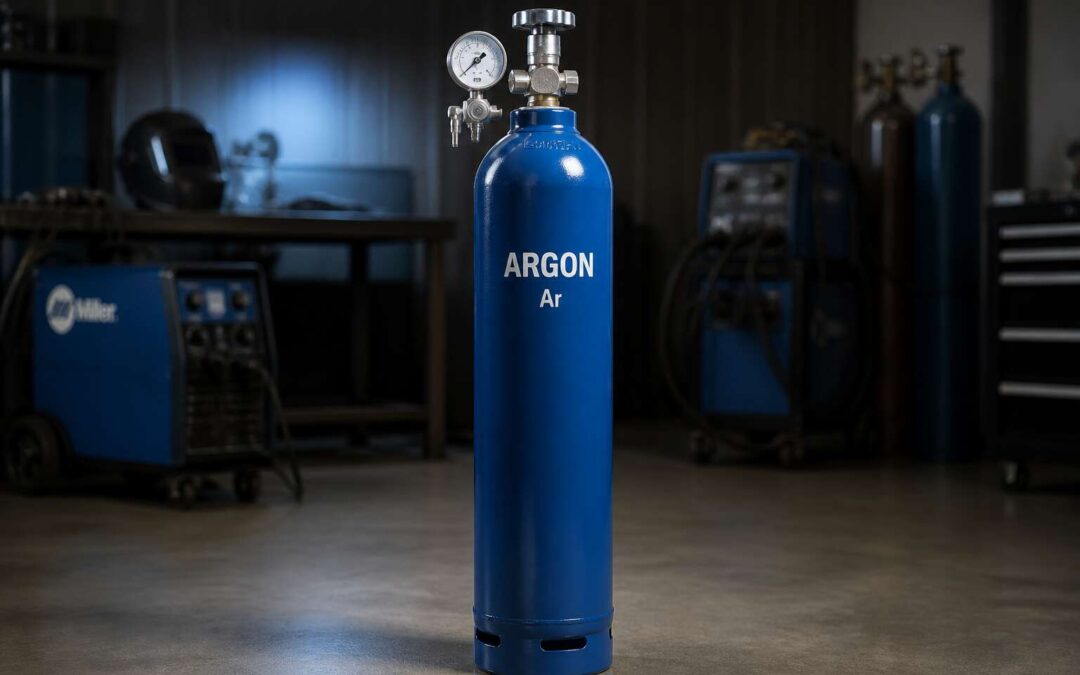
Understanding Argon Gas Cylinders
What Is Argon Gas?
Argon makes up roughly 0.93% of the atmosphere, yet it remains invisible to most people. This noble gas is harvested through fractional distillation of liquid air. It is prized for one defining trait: it refuses to react with other elements.
That refusal matters enormously in welding. When a welder strikes an arc, the hot metal would normally absorb oxygen and nitrogen from the air, creating weak, porous joints. A steady flow from an argon gas bottle forms a shield over the weld pool. The result is a cleaner, stronger bond every time!
Primary Applications in Industry
A single argon gas bottle holds roughly 8.7 cubic metres of gas, a volume that dwarfs the typical welding bay. While shielding the weld pool remains its famous job, industry relies on this cylinder for mundane, yet critical, tasks. In stainless steel mills, argon is blown through molten metal to remove carbon without burning away precious chromium. This process, called argon oxygen decarburization, keeps the alloy tough and rust resistant.
Laser cutting machines also demand a steady supply. The gas flushes away molten slag from the cut, preventing oxidation and producing a clean edge. Other industrial sectors use it for:
- Light bulb and glass manufacturing, where it prevents filament oxidation.
- Semiconductor fabrication, where it acts as a carrier gas for doping agents.
- Food and wine preservation, where it purges oxygen from packaging to extend shelf life.
Each application relies on the same inertness, but the pressure and purity inside the argon gas bottle change according to the job.
Key Advantages Over Other Inert Gases
Helium costs four times more than argon and escapes through microscopic gaps. Neon reacts under electrical stress. Krypton is rare. For most industrial work, an argon gas bottle delivers a denser inert atmosphere that stays where you put it. Density reduces consumption during purging. Stability prevents unwanted reactions.
I have watched operators waste expensive helium because they miscalculated flow rates. Argon reduces the impact of that error. It stays low, covers the weld zone, and does not burn away. Cylinder handling is simpler too, because argon does not require cryogenic storage or special fittings.
- Lower cost per cubic metre.
- Higher density for effective shielding.
- Wide availability in multiple purity grades.
Other gases demand exact conditions. The argon gas bottle simply performs. That reliability is why most workshops choose it first.
Essential Cylinder Specifications
Most argon gas bottles in South Africa arrive charged to about 14,000 kPa, a figure that surprises those who expect a half-filled tank. That pressure is why every argon gas bottle must undergo a hydrostatic test every five years, and why thetare weight stamped on the shoulder matters as much as thegas inside. I check those markings before any connection.
Key specifications define safe, predictable use of your argon gas bottle:
- Tare weight: empty cylinder mass, used to calculate remaining gas;
- Water capacity: internal volume in litres, typically 10 to ̀50 litres;
- Valve type: defines regulator fitting, often BS341 in South Africa;
- Test date: last hydrostatic examination, valid for five years;
Understanding these numbers allows you to measure gas accuratelyand plan jobs without interruption. Without them, you are guessing at volume, pressure, and safety. And with an inert gas, those guesses carry real cost.
Selecting the Right Cylinder for Your Needs
Critical Selection Factors
Compressed argon holds a patient, invisible force. Selecting the right argon gas bottle demands an honest assessment of your workflow. In South Africa, Highveld altitude changes how gas behaves, and transport distances shape delivery timelines. The cylinder’s size, valve type, and tare weight are not minor details. They determine whether your operation runs clean or stalls in frustration.
An argon gas bottle mismatched to its task creates waste. A valve that does not fit your regulator halts production. A cylinder too large becomes a hazard in tight workspaces. A cylinder too small forces constant refills.
- The hydrostatic test date must be current for legal and safety compliance.
- The cylinder capacity should match your consumption rate.
- The outlet thread standard must align with your existing equipment.
The right bottle becomes an invisible certainty, a quiet weight at the edge of your workbench.
Cylinder Sizes and Capacities
A standard 10 litre cylinder at 150 bar delivers roughly 1500 litres of argon, enough for several hours of TIG welding. That fact drives the selection. The common South African sizes break down simply:
- 2 litre: portable, for short repair jobs and limited access.
- 10 litre: the workshop standard.
- 50 litre: bulk supply, for continuous production lines.
The numbers describe water capacity, not the gas inside. A 50 litre cylinder holds five times the gas of a 10 litre, but a full 50 litre unit weighs over 100 kilograms. Moving it across a Highveld workshop is a genuine lift. Match the cylinder to your consumption rate and your floor space. Choose an argon gas bottle that lets you work without interruption, and the weight becomes routine.
Pressure Ratings and Classes
The pressure rating on an argon gas bottle is a specification you cannot ignore. It tells you how much gas you can compress into the same footprint, and it determines whether your existing regulator even fits.
.
In South Africa, three common classes appear:
- 137 bar: legacy units, often cheaper
- 150 bar: standard for repair shops
- 200 bar: production lines, heavier lifting
The 150 bar class is best for most TIG and MIG work. A 200 bar bottle holds over 30 percent more gas than a 150 bar in the same footprint, but thicker walls add significant weight.
But selecting the right class isn’t about chasing pressure. It depends on whether your supplier refills that class,and whether your regulator is rated for it. A 200 bar argon gas bottle often needs a different filling adaptor, which matters if you swap bottles across town.
Safe Handling and Storage Practices
Required Personal Protective Equipment
An argon gas bottle demands respect, not fear. Every year, incidents occur because someone skipped a basic check. In South Africa, where industrial sites range from sprawling mines to compact fabrication units, the routine must never vary!
Always keep the cylinder upright and chained. Position it away from traffic paths and ignition sources. The protective cap should remain threaded on whenever the regulator is detached. Inspect the valve for dust or oil residue before use.
When handling the bottle, wear proper gear. A minimal kit includes:
- Safety glasses with side shields
- Heavy duty leather gloves
- Steel toe boots
These items shield you from impact and accidental discharge. A face shield adds another layer when you tighten connections. No short cut is worth a trip to the emergency room!
Optimal Storage Conditions
A steel vessel holding 150 bar of inert gas deserves more than a random corner. In South Africa, the argon gas bottle requires a shaded, well-ventilated spot with stable temperatures below 50°C. Direct sun accelerates pressure swings, which stresses the valve and seals.
Optimal storage conditions also demand separation. I keep cylinders five meters away from any combustible material or oxygen source. Full and empty units must be segregated, preventing accidental connection to a spent vessel. After each shift, close the valve and bleed the regulator completely.
- Thread the protective cap on whenever the regulator is off
- Chain the bottle upright to a fixed structure
- Inspect the neck and valve area for corrosion every month
Ventilation and Leak Detection Methods
Argon is 1.4 times heavier than air, so a regulator leak settles along the floor and displaces oxygen at ground level. In South African workshops with poor airflow, that silent pooling turns a routine job into a hazard. I have seen an argon gas bottle stood beside a workbench with no thought to where a leak might travel. The gas finds the lowest point and stays there.
Safe handling starts with transport. Use a purpose-built trolley and never drag a cylinder. Keep the cap threaded on when the regulator is disconnected. Secure the argon gas bottle upright at all times.
- Spray soapy water on every joint.
- Watch for bubbles; steady foam means a leak.
- Repeat after each cylinder change.
Ventilation must address argon’s weight. Ceiling fans do little when gas pools near the floor. Install low-level extraction vents or open ground-level doors. Connections wear, so a monthly soap test keeps things honest!
Maintenance and Inspection of Gas Cylinders
Routine Visual Checks
A routine visual inspection is the cheapest insurance your argon gas bottle will ever have. In South Africa, where cylinders rest in workshops under harsh sun, the exterior tells us what is happening inside long before a leak makes itself known.
I always tell operators to look beyond the obvious dent. Check the valve protection cap, the collar, and the foot ring. Rust, especially where the cylinder meets damp ground, is a warning sign that should never be ignored!
Watch your argon gas bottle for these damage indicators:
- Cracks or bulges in the metal, however small
- Damaged or missing valve protection caps
- Corrosion around the neck threads
- Discolouration or scorching on the paint
A damaged valve seat can cause a slow leak that your nose will not catch in a ventilated space. Argon remains odourless and colourless, so the physical state of the bottle becomes your only early signal.
Hydrostatic Testing Procedures
Hydrostatic testing is the most rigorous examination an argon gas bottle will ever face. Every five years, the cylinder is drained completely, filled with water, and pressurised to roughly one and a half times its working pressure. The steel walls must stretch within acceptable limits, then return to their original shape. Permanent expansion beyond tolerance means the bottle is condemned on the spot.
South African regulations under SANS 10019 define this process. The test date is stamped into the neck, so a conscientious supplier checks this before every refill.
The procedure evaluates several factors:
– Internal volume before and after pressurisation
– Calculated expansion rates against legal thresholds
– Condition of neck threads and foot ring under stress
Valve Maintenance and Replacement
The valve on an argon gas bottle does more than open and close. It guards the pressurised contents against contamination and sudden release. Over years of use, the valve’s internal seals lose their flexibility, and the brass body develops micro-cracks from thermal cycling. A thorough inspection includes checking the valve stem for play, the outlet threads for damage, and the safety relief device for debris. I have seen cylinders arrive with bent handwheels and rusty caps, warning signs that demand immediate retirement.
Replacement is not a do-it-yourself task. In South Africa, only registered gas suppliers may remove and fit valves, using torque settings from the manufacturer. A loose valve can cause a slow leak that empties a cylinder overnight. A cracked valve can turn a simple swap into a dangerous event. Regular servicing of the valve, including lubrication of the spindle and verification of the burst disc, keeps the argon gas bottle performing reliably until the next hydrostatic test arrives.
Diagnosing Common Leak Issues
An argon gas bottle can develop a leak in places that have nothing to do with the valve. The sidewall, the base ring, and the threaded neck all suffer from corrosion, dings, and weld fatigue over time. A simple soap and water solution, applied with a squirt bottle, reveals bubbles at the source. Check the regulator connection first, because a worn ferrule or a loose nut creates a hiss that is easy to mistake for a valve issue. Also inspect the cylinder’s paint for blisters, which indicate hidden rust.
Common leak spots include:
- The base ring where moisture pools.
- The neck threads under the collar.
- The sidewall after a hard knock.
Each of these requires a different response. A leak at the neck often means the argon gas bottle is condemned, not repairable. A leaking sidewall dent might be serviceable if a hydrotest is due, but never assume. Leaks are often the first sign that the cylinder’s metal has thinned.
Environmental and Regulatory Considerations
Disposal and Recycling Options
An argon gas bottle is benign in service, but its end of life creates a regulatory puzzle for South African companies. The gas itself is inert, yet the cylinder is a pressure vessel, so you cannot simply send an argon gas bottle to landfill. The Occupational Health and Safety Act and municipal bylaws govern pressurised containers.
Disposal options vary by region. I have seen the responsible route involve gas recovery, valve removal, and decommissioning at a licensed facility. Your choices are usually limited to:
- Returning the unit to the original supplier for refill or refurbishment.
- Engaging a certified scrap dealer who will verify the bottle is valve-less and pressure-free before crushing it.
Recycling the steel from a single argon gas bottle saves about 1.5 tonnes of carbon emissions, a useful metric for your annual sustainability report.
Transportation Compliance Rules
Transporting an argon gas bottle across South Africa presents its own compliance demands. Under the National Road Traffic Act, a cylinder becomes a dangerous good the moment it leaves your premises. It is classified as UN 1006, class 2.2. That status triggers obligations that don’t apply to ordinary freight.
The SANS 10228 code requires secure cradles, inert gas signage, and a driver with a valid dangerous goods permit. Even a short hop from Johannesburg to Ekurhuleni demands orange plates. I have seen firms overlook this until a weighbridge inspection.
Many operators assume that because argon is inert, it avoids paperwork. It doesn’t. The law treats its pressure as a hazard, even if the gas won’t ignite. The argon gas bottle’s journey only ends when it returns to a certified depot.
OSHA and Local Safety Standards
The regulatory gaze on the argon gas bottle does not soften once it rests on your floor. In South Africa, the Occupational Health and Safety Act and its Construction Regulations demand more than a passing nod. OSHA style frameworks, while American in origin, echo through local enforcement expectations around worker exposure and cylinder integrity. I have watched facilities pass audits simply because their paperwork matched their physical reality.
Local standards such as SANS 10219 govern filling and inspection intervals. The Department of Employment and Labour holds the power to enter without warning. Inspectors typically check:
– Training records for staff who handle compressed gas
– Certification documentation for each cylinder in service
– Emergency response plans posted in visible areas
Each missing document weakens your defence. Non-compliance brings fines, not warnings. The argon gas bottle remains a regulated asset, and every custodian must answer for it.
Reducing Carbon Footprint in Argon Use
Argon gas bottle production demands electricity for cryogenic air separation. South Africa’s coal dependent grid amplifies the carbon cost of every cylinder. So the quiet work of reducing emissions starts with supply chain choices. I have audited facilities where usage was wasteful. Leaks went unnoticed for months. Delivery trucks arrived half full. The remedy was not heroic. It required attention to consumption patterns.
Three levers reduce emissions:
- Minimise gas loss through proper valve maintenance.
- Combine deliveries to cut transport emissions.
- Select vendors who offset their energy use.
Each lever has a measurable effect. The argon gas bottle, once filled, carries a carbon cost. Its true price includes the coal burned to create it. I have seen companies ignore this until their bills demanded respect. The emission numbers do not disappear!
Emerging Trends in Gas Cylinder Technology
South African regulators are finally treating gas cylinders like the industrial citizens they are. New compliance frameworks demand more than a stamped date and a prayer. Every argon gas bottle now faces stricter scrutiny on material traceability and end of life handling. The days of a battered cylinder quietly retiring behind a workshop are numbered. Enforcement is uneven, but the direction is clear.
Meanwhile, technology is dragging cylinder design into the present. Composite overwrapped pressure vessels are shedding weight without shedding safety. Smart valves with embedded sensors report pressure, temperature, and tampering in real time. Some fleets now track argon gas bottle locations through telematics, which pleases logistics managers and mildly unsettles drivers.
- Bluetooth connected regulators for remote leak monitoring
- Cylinders with recyclable thermoplastic liners
- AI driven fill scheduling based on usage patterns
The argon gas bottle is no longer a passive steel tube. It is becoming a data node, a compliance document, and a liability shield, all at once.